

Scientists have unveiled a link between metabolites of fatty acids in cord blood and symptoms of autism spectrum disorder in children.
Autism spectrum disorder (ASD) is a neurodevelopmental condition that influences the learning abilities and social interactions of individuals. In recent decades, there has been a significant increase in awareness about ASD, including its occurrence and impact on those who are diagnosed. Nevertheless, many facets of ASD remain poorly understood, indicating that there is still much to learn.
Although the exact causes of ASD are unclear, currently available evidence points to neuroinflammation as a major factor. Several studies in mouse models of ASD have hinted at the importance of polyunsaturated fatty acids (PUFA) and their metabolites during pregnancy in playing a key role in ASD development. PUFA metabolites regulated by the cytochrome P450 (CYP) affect fetal development in mice causing impairments closely linked to ASD symptoms. However, it is still unclear if the same is true for humans and needs further investigation.
Study on CYP-PUFA Levels and ASD
To address this knowledge gap, a research team from Japan consisting of Professor Hideo Matsuzaki from the Research Center for Child Mental Development, University of Fukui, Dr. Takaharu Hirai at the Department of Psychiatric and Mental Health Nursing, School of Nursing, University of Fukui and Dr. Naoko Umeda from the Department of Maternal and Child Health Nursing, School of Nursing, University of Fukui, analyzed the CYP-PUFA levels in neonatal umbilical cord blood samples. Their study, published in the journal Psychiatry and Clinical Neurosciences, sheds light on the possible causes of ASD.
Sharing the motivation behind their study, Prof. Matsuzaki explains, “CYP metabolism forms both epoxy fatty acids (EpFAs), which have anti-inflammatory effects, and dihydroxy fatty acids, or ‘diols,’ which have inflammatory properties. We hypothesized that the dynamics of CYP-PUFA metabolites during the fetal period, that is, lower EpFA levels, higher diol levels, and/or increased EpFA metabolic enzymes would influence ASD symptoms and difficulties with daily functioning in children after birth.”
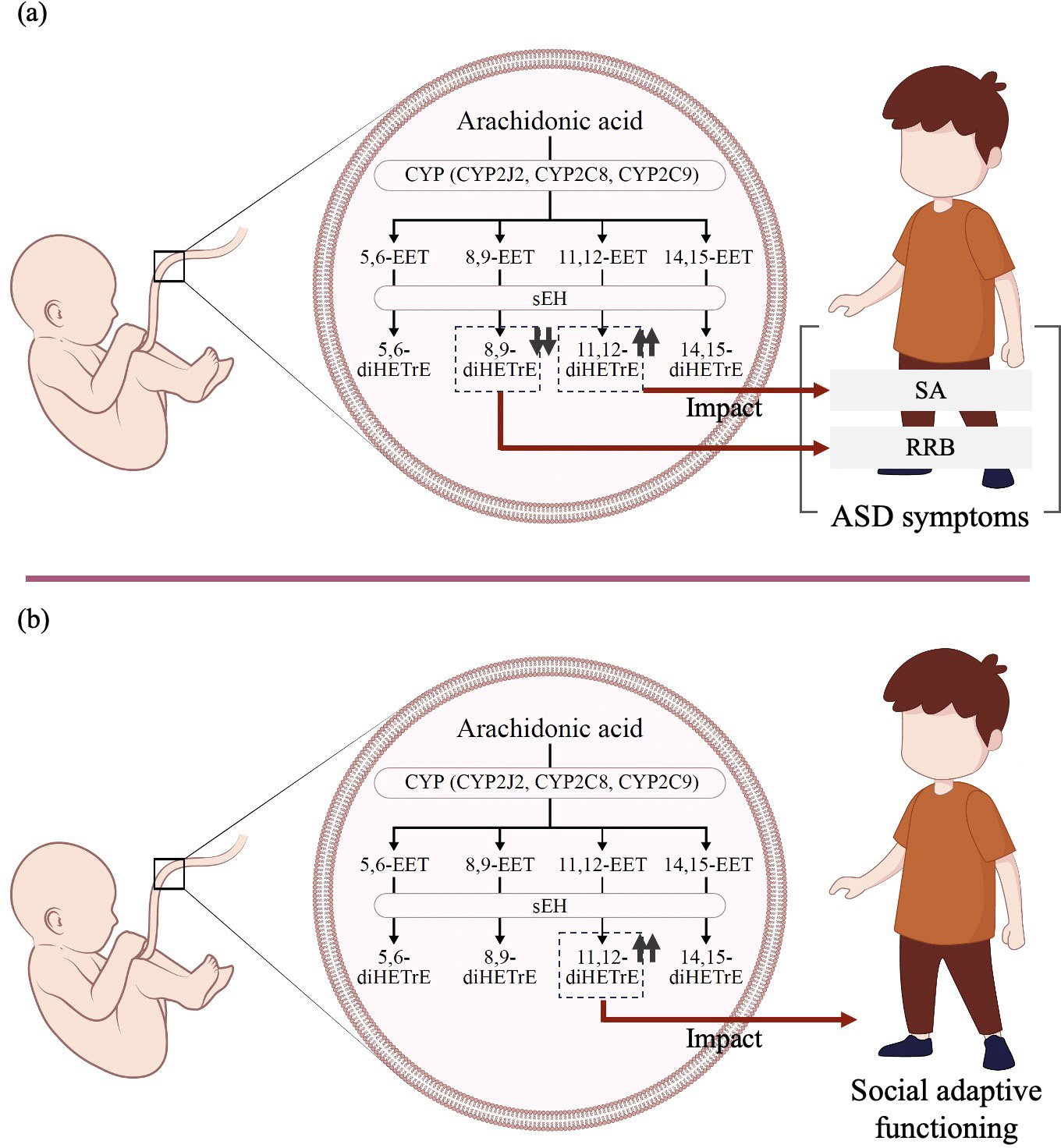
To test this hypothesis, the researchers investigated the link between PUFA metabolites in umbilical cord blood and ASD scores in 200 children. The cord blood samples had been collected immediately after birth and preserved appropriately, whereas ASD symptoms and adaptive functioning were assessed when the same children were six years old, with the help of their mothers.
After careful statistical analyses of the results, the researchers identified one compound in cord blood that may have strong implications for ASD severity, namely 11,12- dihydroxyeicosatrienoic acids (diHETrE), a dihydroxy fatty acid derived from arachidonic acid.
Implications of the Findings
“The levels of diHETrE, an arachidonic acid-derived diol, in cord blood at birth significantly impacted subsequent ASD symptoms in children and were also associated with impaired adaptive functioning. These findings suggest that the dynamics of diHETrE during the fetal period is important in the developmental trajectory of children after birth,” highlights Prof. Matsuzaki.
More specifically, the researchers found that higher levels of the molecule 11,12-diHETrE had an impact on social interactions, whereas low levels of 8,9-diHETrE impacted repetitive and restrictive behaviors. Moreover, this correlation was more specific for girls than for boys. This newfound knowledge could be crucial in understanding, diagnosing, and potentially preventing ASD. By measuring diHETrE levels at birth, it may be possible to predict the likelihood of ASD development in children.
“The effectiveness of early intervention for children with ASD is well established and detecting it at birth could enhance intervention and support for children with ASD,” muses Prof. Matsuzaki. He also adds that inhibiting diHETrE metabolism during pregnancy might be a promising avenue for preventing ASD traits in children, although more research will be needed in this regard.
In conclusion, these findings open a promising avenue for researchers unraveling the mysteries surrounding ASD. We hope that enhanced understanding and early diagnostics will be able to improve the lives of people with ASD and their families.
Reference: “Arachidonic acid-derived dihydroxy fatty acids in neonatal cord blood relate symptoms of autism spectrum disorders and social adaptive functioning: Hamamatsu Birth Cohort for Mothers and Children (HBC Study)” by Takaharu Hirai, Naoko Umeda, Taeko Harada, Akemi Okumura, Chikako Nakayasu, Takayo Ohto-Nakanishi, Kenji J. Tsuchiya, Tomoko Nishimura and Hideo Matsuzaki, 23 July 2024, Psychiatry and Clinical Neurosciences.
DOI: 10.1111/pcn.13710
This work was supported, in part, by KAKENHI from the Ministry of Education, Culture, Sports, Science and Technology of Japan (19K21754, 22H00492). This work was also partially supported by the Life Science Innovation Center, the University of Fukui, and the Center of Developmental Education and Research.
Never miss a breakthrough: Join the SciTechDaily newsletter.
Follow us on Google and Google News.
1 Comment
I don’t believe a word. The next to last study on ASD jumped to the conclusion that the culprit was ftalates or some similar scary thing. Hard times for biological sciences, it seems.